

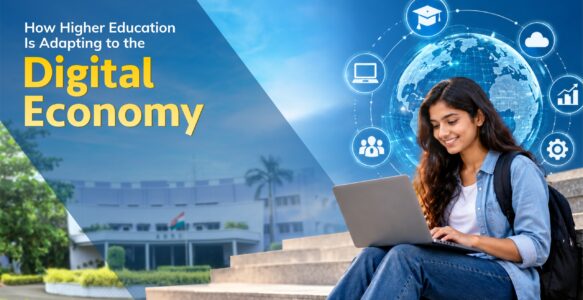
Think about the career you want five years from now. Will the skills you learn today still be relevant? With Artificial Intelligence, automation, and digital technologies transforming industries, this is a question every student should consider.
Higher education in the digital economy is no longer just about earning a degree. It is about gaining the knowledge, technical abilities, and practical experience needed to succeed in a technology-driven world.
So, how are universities changing to prepare you for this future? Let’s explore.
Why Is Higher Education Changing?
The workplace you are preparing to enter looks very different from the one that existed a decade ago.
Businesses increasingly depend on AI, data analytics, automation, and digital platforms. Naturally, employers are looking for graduates who can adapt to these technologies and apply their knowledge to real-world situations.
This is where digital transformation in higher education becomes important. Universities are gradually moving beyond traditional teaching methods to introduce interdisciplinary courses, practical training, digital tools, and industry-integrated learning.
The goal is simple: prepare you not just for your first job, but for a career that continues to evolve.
How Technology Is Transforming University Education
Technology in higher education is changing both what you learn and how you learn it.
Modern educational approaches increasingly include:
- Smart Learning: Digital classrooms, online resources, and interactive learning platforms.
- AI & Data Analytics: Understanding intelligent technologies and data-driven decision-making.
- Practical Learning: Simulations, case studies, research projects, and technology-based assignments.
- Interdisciplinary Education: Combining subjects such as business, technology, economics, and analytics.
These developments demonstrate how higher education is adapting to the digital economy, helping students connect academic concepts with modern professional requirements.
How Universities Are Redesigning Education for the Digital Age
Universities are not just introducing new technologies; they are also rethinking how education is delivered. Traditional subject-focused learning is gradually making room for interdisciplinary programmes, flexible learning approaches, and practical skill development.
For instance, combining Economics with Data Science or Management with Business Analytics allows students to understand how different disciplines work together in real-world industries.
This shift helps universities prepare graduates who can adapt to changing technologies, explore diverse career paths, and solve complex professional challenges.
Future-Ready Skills Every Student Should Develop
You don’t necessarily need to become a programmer to succeed in the digital economy. However, understanding technology and knowing how to work alongside it can give you a significant advantage.
Some essential future-ready skills for students include:
- Digital literacy and AI awareness
- Data interpretation and analytical thinking
- Critical thinking and problem-solving
- Communication and collaboration
- Creativity and innovation
- Adaptability and continuous learning
These industry-relevant skills are valuable across management, engineering, finance, healthcare, marketing, and several other professional fields.
Remember, technology will continue changing. Your ability to learn and adapt will remain one of your greatest strengths.
Why Industry-Oriented Education Matters
Imagine learning business analytics without examining real business data or studying technology without understanding its practical applications.
That is why Industry-oriented education plays an important role in modern universities.
Internships, live projects, corporate interactions, industry workshops, and professional mentorship help you understand how classroom knowledge translates into workplace responsibilities.
The role of higher education in the digital economy is therefore not limited to delivering academic knowledge. It also involves helping students develop confidence, practical abilities, and professional readiness.
Career Opportunities in the Digital Economy
As industries embrace technology, new career paths are emerging alongside traditional professions.
Some promising career opportunities in the digital economy include:
- Artificial Intelligence and Machine Learning
- Data Science and Business Analytics
- Cybersecurity and Cloud Computing
- Digital Marketing and E-commerce
- Financial Technology
- Business Intelligence and Technology Management
The future job opportunities for graduates will depend on their qualifications, practical skills, and ability to keep learning as industries evolve.
Choosing an interdisciplinary, career-focused programme can help you prepare for these changing possibilities.
How ASBM University Prepares You for the Digital Future
If you are exploring a top private university in Odisha, ASBM University offers an academic environment focused on combining modern education with professional development.
By combining technology-focused academic programmes with industry-oriented learning, ASBM University helps students develop the analytical, digital, and professional skills needed in today’s evolving economy.
Technology-Focused Academic Programmes:
Students exploring B.Tech AI and ML or Data Science courses in Odisha can consider ASBM University’s technology-focused programmes, including Computer Science and Information Technology, AI and Machine Learning, and Economics and Data Science.
Industry Exposure & Practical Learning:
Through internships, live projects, industry interactions, professional workshops, and placement preparation, students gain opportunities to connect academic learning with workplace expectations.
Global Collaborations & Student Development:
International academic collaborations introduce students to global perspectives, while skill-development initiatives support communication, leadership, and professional growth.
ASBM University also offers scholarship opportunities of up to ₹1,00,000 for eligible students, supporting access to higher education.
Excellent Placement & Career Support:
ASBM University helps students prepare for professional careers through its dedicated Career Development Cell. With corporate connections, placement training, mock interviews, career counselling, and professional grooming sessions, students gain the confidence and skills needed to approach recruitment opportunities and transition smoothly from campus to the corporate world.
Conclusion
Higher education in the digital economy is evolving beyond traditional classrooms through technology-integrated learning, interdisciplinary programmes, and industry-focused skill development. Choosing a university that embraces these changes can help you prepare for tomorrow’s career opportunities.
Explore ASBM University’s future-focused programmes and build the skills to thrive in the digital economy.