

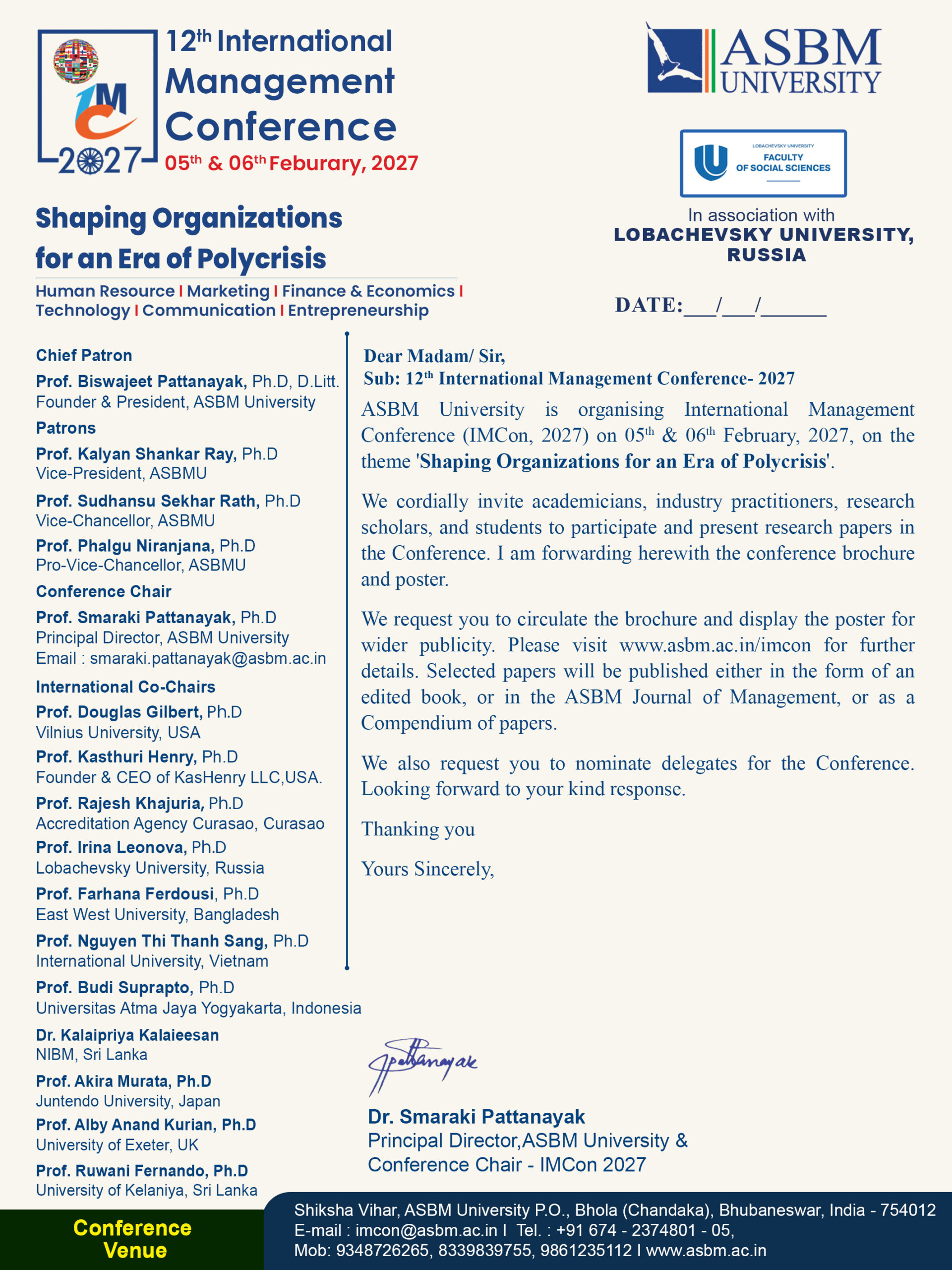
Shaping Organizations for an Era of Polycrisis.
Human Resource | Marketing | Finance & Economics
Technology | Communication | Entrepreneurship
DATE: 05 & 06 FEB 2027

About IMCon 2027
The greatest danger in times of turbulence is not the turbulence—it is to act with yesterday’s
logic.
— Peter F. Drucker
An unprecedented convergence of global challenges characterizes the twenty-first century. Climate change, geopolitical conflicts, economic volatility, technological disruption, pandemics, cyber threats, demographic transitions, and widening social inequalities are no longer isolated events; they interact, reinforce one another, and create cascading consequences across societies, economies, and institutions. This interconnected web of crises is increasingly described as polycrisis—a condition in which multiple systemic risks combine to produce impacts far greater than the sum of their individual effects.
Originally introduced by the French philosopher Edgar Morin and later brought into contemporary discourse by economic historian Adam Tooze, the concept of polycrisis has become central to discussions on global governance, sustainable development, and organizational resilience. It underscores a new reality: in today’s interconnected world, a disruption in one system can rapidly trigger crises across others. Recent geopolitical tensions, for instance, have affected energy security, disrupted supply chains, intensified inflation, and heightened food insecurity, while climate-induced disasters continue to challenge economic stability and human well-being worldwide.
These developments reveal the limitations of conventional management approaches. Traditional models built on linear planning, compartmentalized decision-making, and short-term responses are increasingly inadequate for addressing multidimensional and interconnected risks. Organizations today require a new paradigm—one that embraces systems thinking, anticipatory leadership, strategic agility, technological innovation, and sustainable value creation.
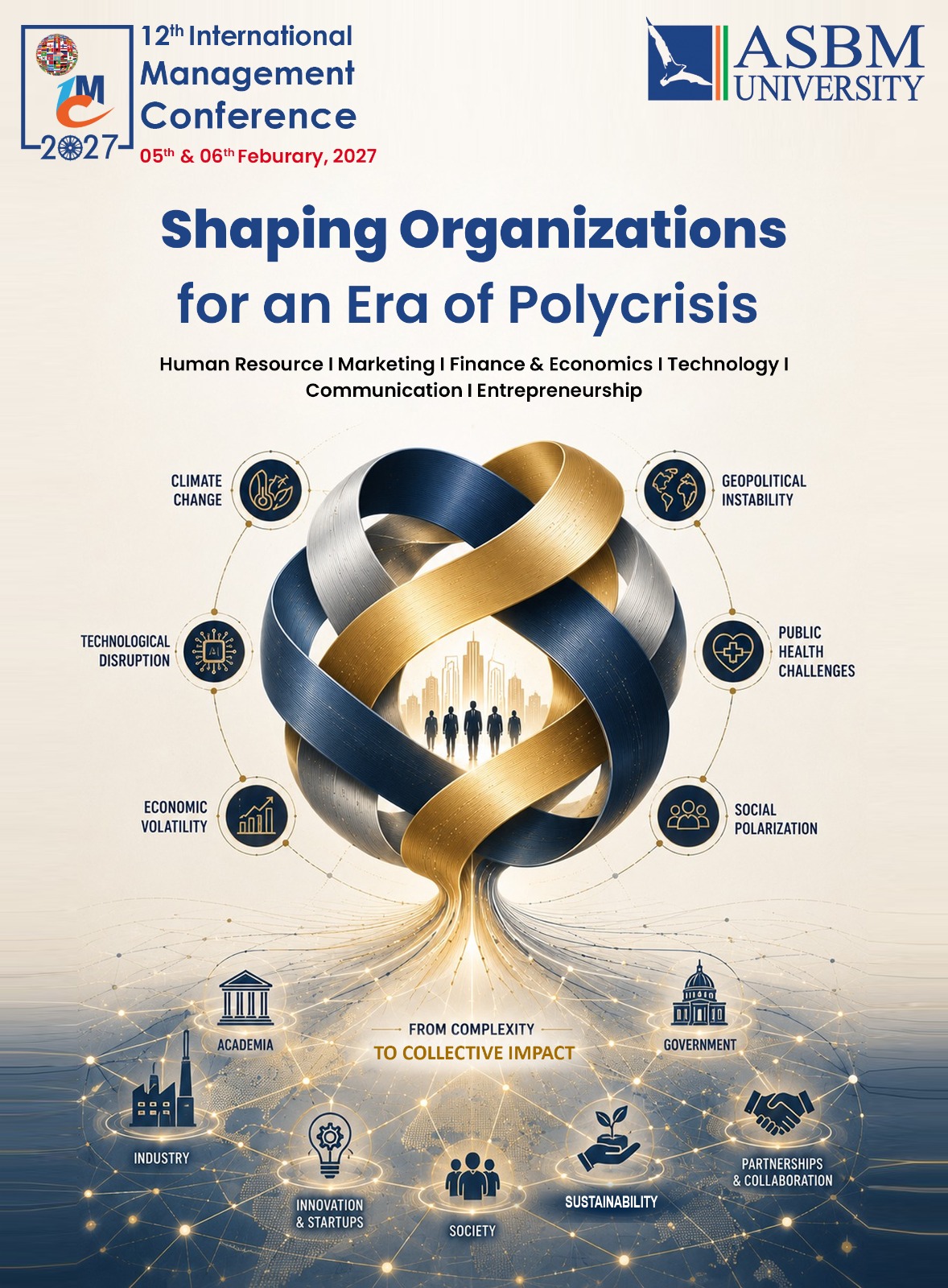
The era of polycrisis calls for leaders who can navigate uncertainty with resilience, foster collaboration across sectors, and balance economic performance with social responsibility and environmental stewardship. Future-ready organizations will be those that integrate ethical governance, digital transformation, innovation, and human-centered leadership into their strategic vision. Resilience must no longer be viewed merely as the ability to recover from disruption, but as the capacity to adapt, transform, and thrive amid continuous change.
Marshall McLuhan’s vision of the Global Village has never been more relevant. Advances in communication and technology have brought the world closer together, creating unprecedented opportunities for collaboration and knowledge exchange. Yet the same interconnectedness has also amplified shared vulnerabilities, making collective action and global cooperation indispensable for addressing complex challenges. Building resilient organizations, therefore, requires partnerships that transcend geographical boundaries and disciplinary silos.
Against this global backdrop, ASBM University proudly presents the 12th International Management Conference (IMCON 2027) under the theme “Shaping Organizations for an Era of Polycrisis“. As a multidisciplinary institution committed to excellence in management, technology, innovation, and social responsibility, ASBM University seeks to provide a vibrant international platform for scholars, industry leaders, policymakers, entrepreneurs, researchers, and students to exchange ideas and co-create solutions for an increasingly complex world.
IMCon 2027 aims to stimulate interdisciplinary dialogue on organizational resilience, responsible leadership, digital transformation, sustainability, artificial intelligence, governance, entrepreneurship, and the future of work. Through keynote addresses, panel discussions, research presentations, and collaborative engagements, the conference will encourage participants to explore innovative frameworks that combine systems thinking, evidence-based decision-making, and ethical leadership to address emerging global challenges.
More than a forum for academic exchange, IMCon 2027 aspires to inspire collective action. It seeks to foster meaningful partnerships between academia, industry, government, and civil society to promote resilient, inclusive, and sustainable organizations. By encouraging fresh perspectives and collaborative innovation, the conference aims to contribute to shaping institutions that are agile in times of uncertainty, responsible in governance, and committed to creating enduring value for society.
As we confront one of the most transformative periods in human history, IMCon 2027 invites the global academic and professional community to reimagine organizations not merely as engines of economic growth, but as catalysts for sustainable development, ethical leadership, and societal well-being. Together, let us transform the challenges of polycrisis into opportunities for innovation, resilience, and shared prosperity.
Important Dates
Full Paper Submission Deadline- 30 September, 2026
Early Bird Registration Deadline- 15 November, 2026
Abstract Submission Deadline: 7th September 2026
Conference Dates – 05-06 February, 2027
Register now for ASBMU IMCon 2027 by clicking the registration button or simply scan the QR code to complete your registration instantly.



Organizing Committee
Prof. Biswajeet Pattanayak, Ph.D, D.Litt.
Founder & President, ASBM University
Vice-President, ASBM University
Vice-Chancellor, ASBM University
Pro-Vice-Chancellor, ASBM University
Prof. Smaraki Pattanayak, Ph.D
Principal Director, ASBM University
smaraki.pattanayak@asbm.ac.in
Professor, Vilnius University
Professor Emeritus, ASBM University
Director of Postgraduate MSc programmes, University of Exeter, UK
Senior Consultant, National Institute of Business Management, Sri Lanka
Founder and CEO of KasHenry LLC, USA., CFO & COO of TechFides, USA
Senior Faculty, International University-VNU HCMC, Vietnam
Associate Professor, Faculty of International Liberal Arts, Juntendo University, Japan
Prof. Rajesh Khajuria, Ph.D
Global Ambassador, Accreditation Agency Curasao, Curasao
Prof. Ruwani Fernando, Ph.D
Professor, Dept. of Finance, University of Kelaniya, Sri Lanka
Prof. Budi Suprapto
Dean, Faculty of Business & Economics, Universitas Atma Jaya Yogyakarta, Indonesia
Professor, International Affairs,
Lobachevsky University, Russia
Prof. Farhana Ferdousi, Ph.D
Chairperson,
Dept. of Business Administration, East West University, Bangladesh